
CalfExpert
The CalfExpert is THE state-of-the-art calf feeder, featuring individual calf feeding, a whole milk system, intuitive controls and a host of features.

Improved work flexibility: data analysis via an app assists professional management.

Better rearing performance through weighing. Early inspections and alerts reduce veterinary costs.

Natural drinking behaviour: healthy development thanks to multiple personalised feeds.
A modern calf feeder
CalfExpert is a calf feeder that has been developed to meet the latest standards in calf feeding. State-of-the-art feeding technology ensures that the milk for the calves is always freshly mixed. It does not matter whether milk replacer or pasteurised whole milk is used. CalfExpert prepares the milk automatically and individually for each animal.
You, as farmer, remain completely flexible in your work schedule while calves are fed 24/7. The calf feeder takes your calf rearing management to a whole new level.
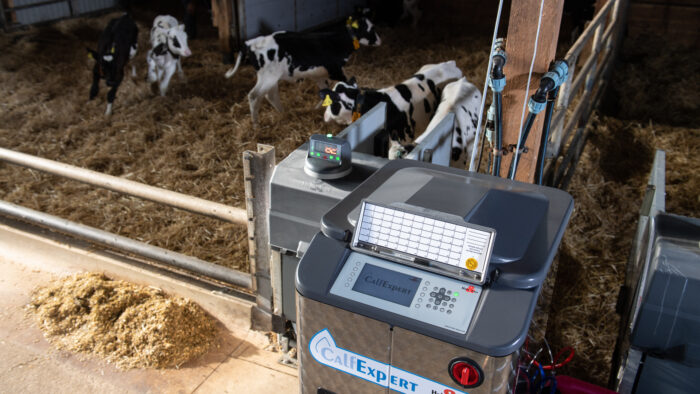
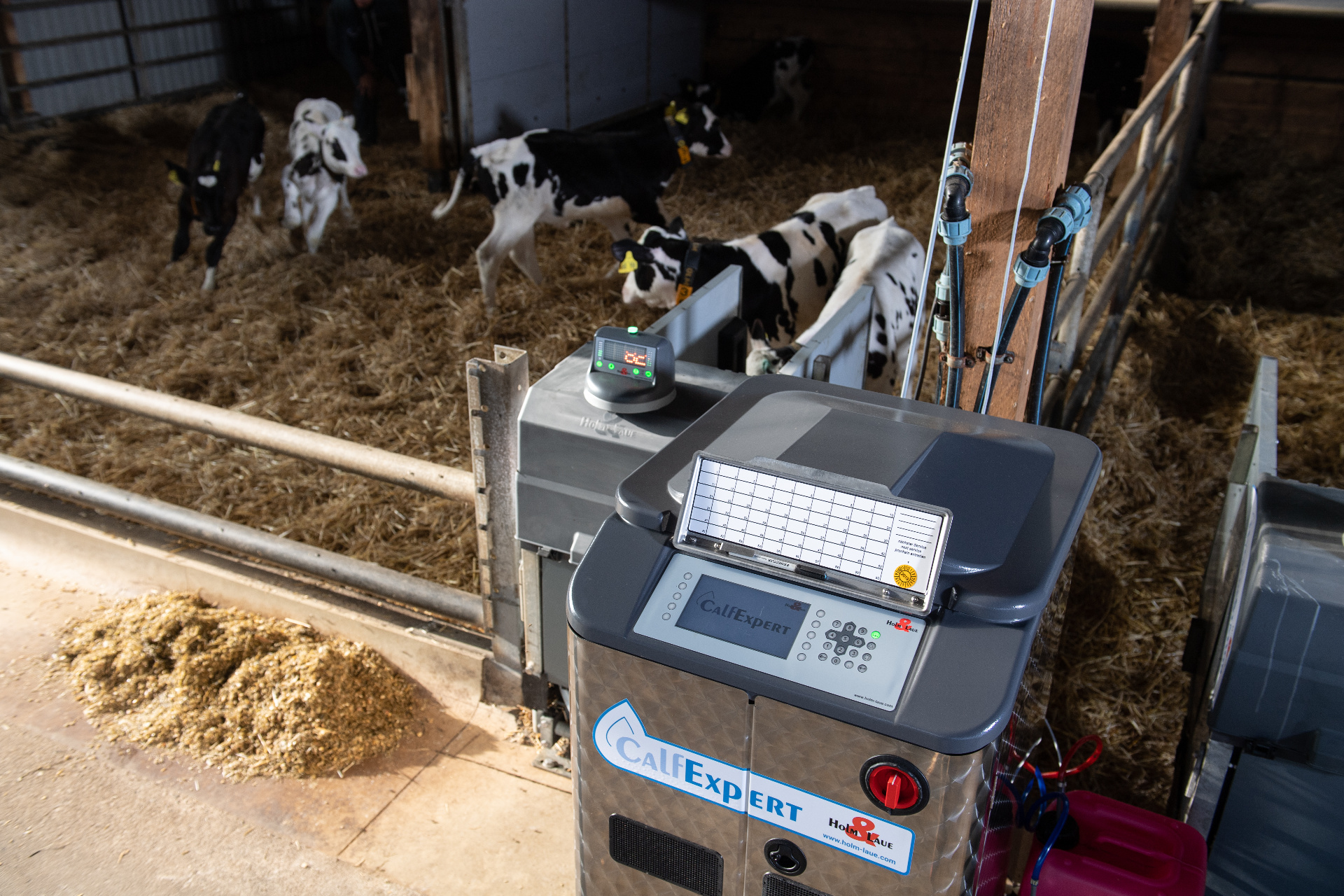
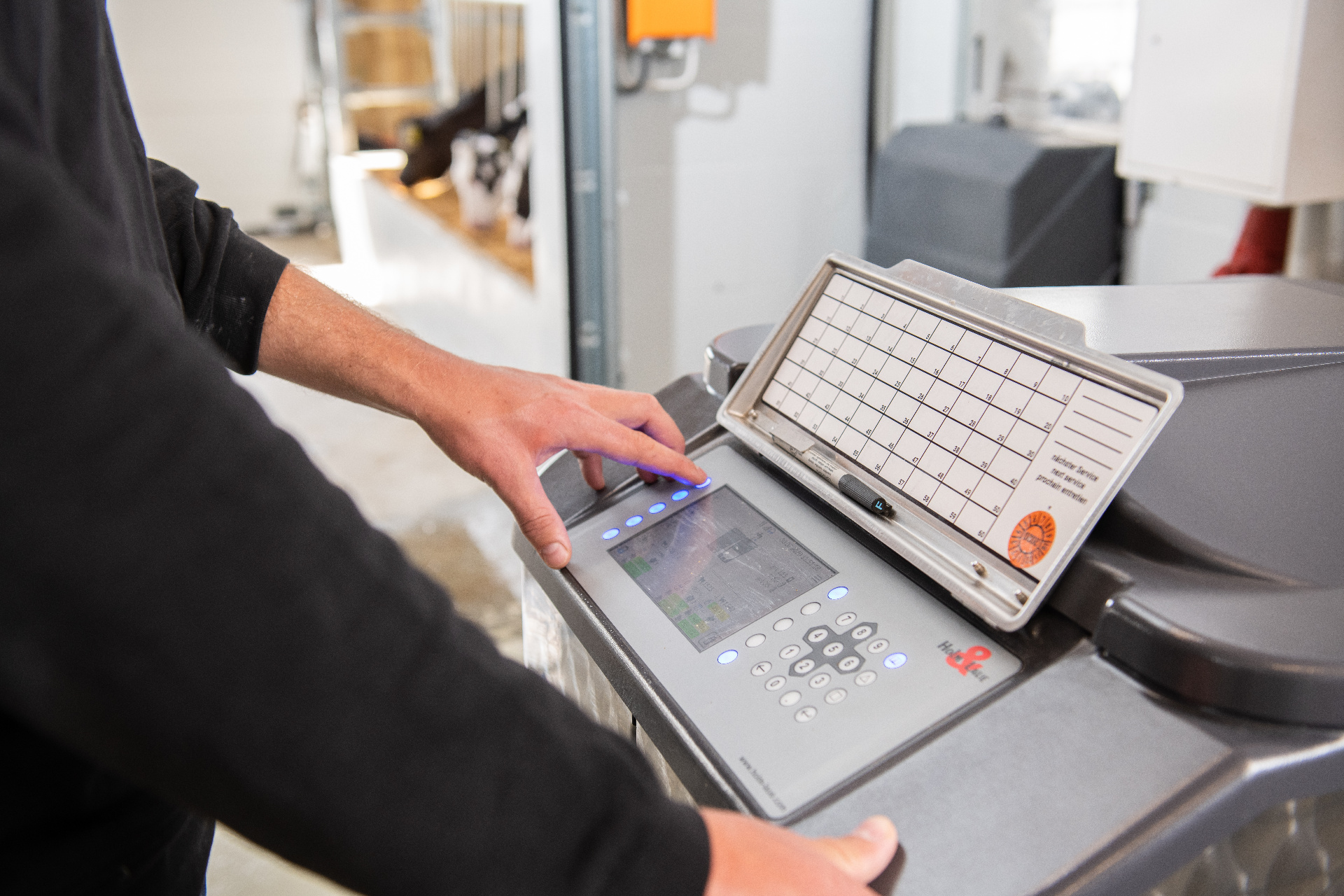
Intuitive operation via the graphic display and the link to the CalfGuide mobile app make it easier for you and your team to monitor your animals. All the information about your calves, status reports and alerts are at your fingertips in the app and directly on the calf feeder at all times.
Different feeding programmes form the basis of successful and performance-oriented calf rearing in automatic calf feeding. Labour savings and complete supervision included.


One unit – many advantages
What can the CalfExpert do? How does it improve calf welfare and working conditions? What are its key functions? You can learn about all this here in a nutshell:
Individual animal feeding
Feeding a large number of calves with a fresh mix adapted to each individual calf is a major challenge. CalfExpert makes it child's play.
Always freshly mixed
The CalfExpert calf feeder mixes the milk fresh for each calf. Any residual milk is kept warm and flushed out of the system following longer drinking breaks. Other calf feeders work with a central milk supply. In milk stored this way at 40 °C, the bacterial count doubles every 20 minutes. In contrast, the CalfExpert guarantees maximum hygiene and feeding suitable for every individual animal.
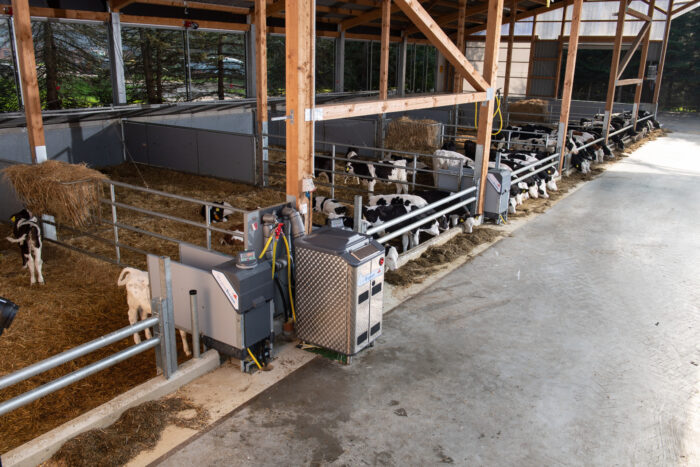
Individual adaptation
A central milk supply has another major disadvantage: modern feeding programmes (e.g. metabolic programming) require a higher CMR concentration (e.g. 160 g/l) at the beginning of rearing to stimulate performance. However, a lower milk replacer powder concentration (130 g/l) is necessary in the weaning phase. This individual animal feeding can only be achieved if the mix is prepared individually for each calf, as is the case with CalfExpert.
QuickChange logic for greater performance
We have accelerated the mixing process and the change of calves in the CalfExpert, thereby optimising utilisation of the HygieneStations.
Milk is mixed quickly and can be called up at the feeding station after just 3 seconds. Once the milk meal is finished, a switch is immediately made to the second feeding station. Here, a second calf can be fed immediately while the first is still satisfying its need to suckle.
In addition, priorities can be specified in the CalfExpert menu so that young or sick calves are given preferential treatment. The tried and tested flexitime programme ensures that meals are distributed very evenly throughout the day without clusters of visits to the stations. The result is reduced waiting times with high animal occupancy and a positive "visiting experience" for the calves.
Enjoy calm and compliant calves
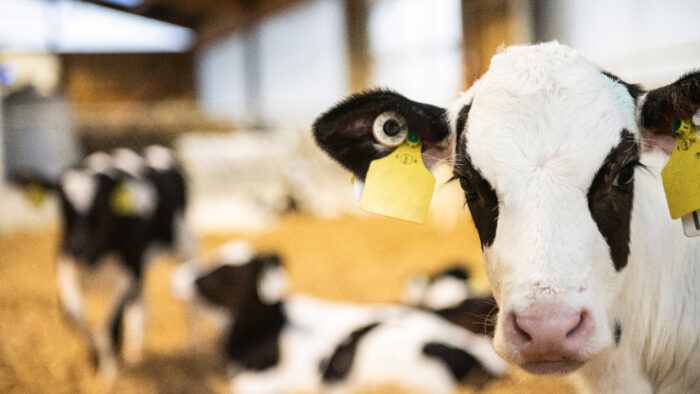
Since CalfExpert does not restrict feeding to certain times of day, calves can come and feed at any time. Your calves will no longer see you as a nurse and will therefore remain calm when people enter the barn. Younger and weaker calves have all the time they need to consume their full ration.
As the CalfExpert also works with an intelligent credit logic, all calves have a feeding credit at a different time. As a result, fewer animals crowd around the station. The anti-pirate milk valve ensures that stronger calves do not steal milk. The result: extremely uniform, relaxed groups of calves.
QuadroFlex: simultaneous and yet flexible feeding
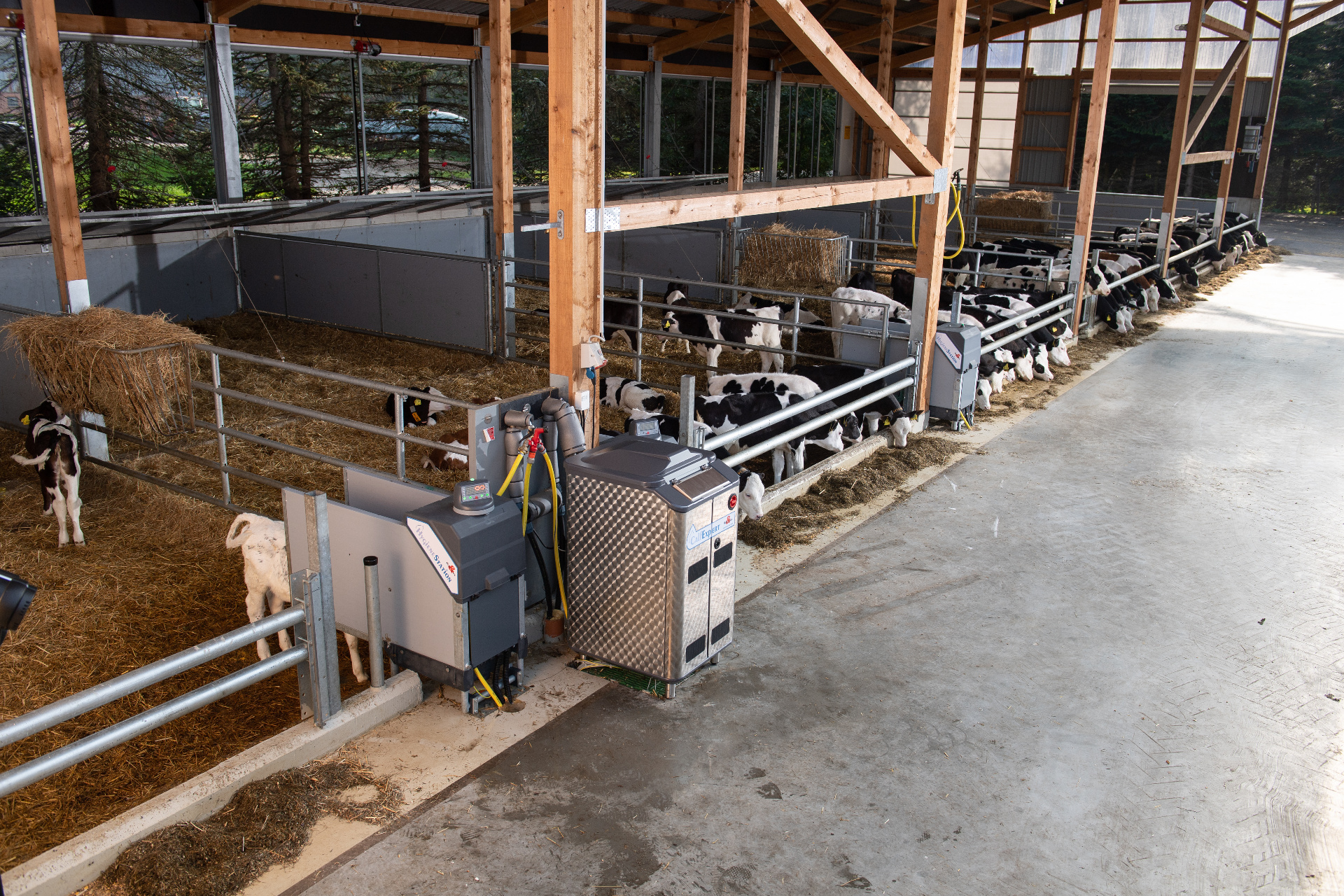
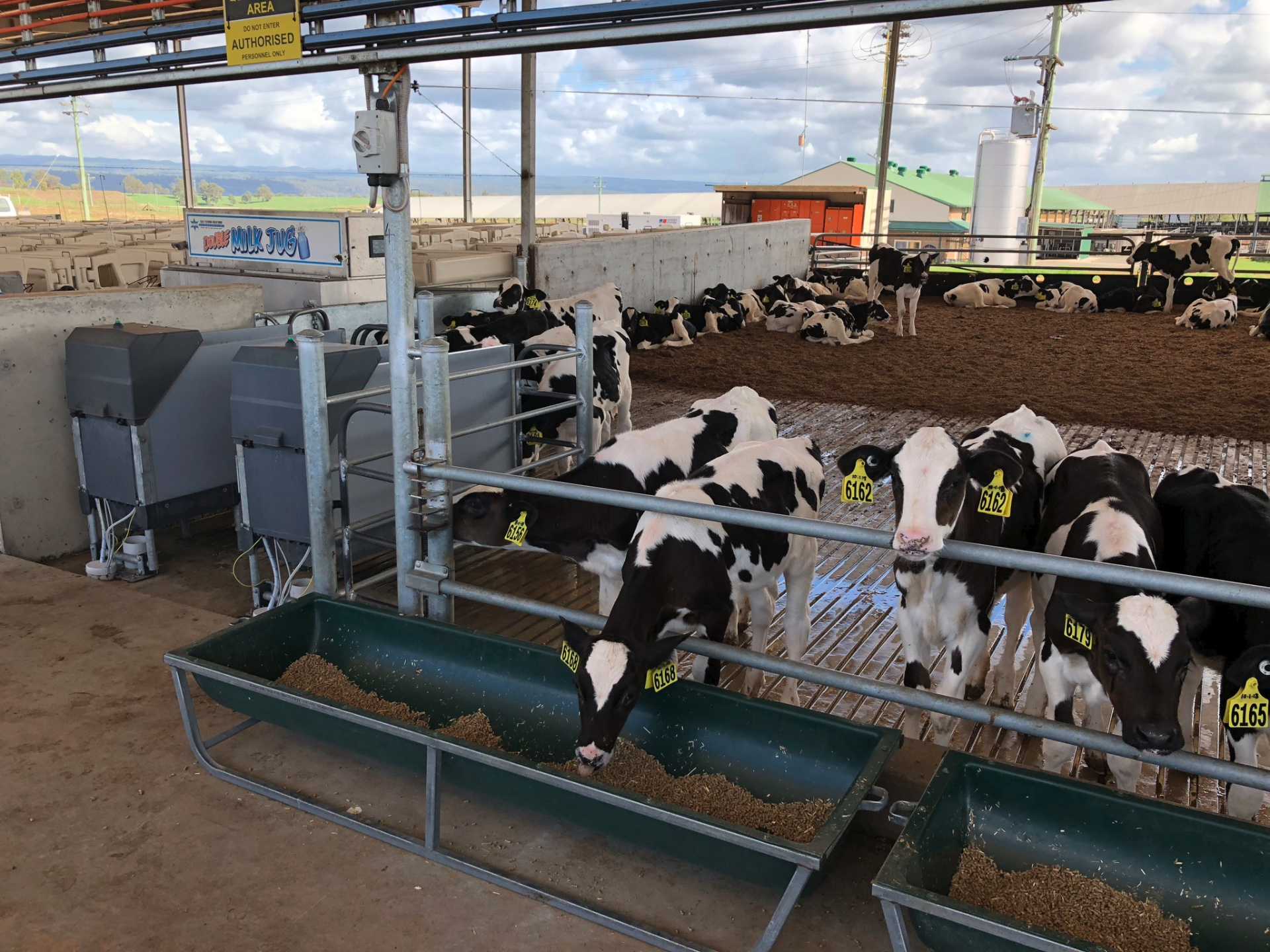
With the new QuadroFlex system, four calves can feed at the same time at two PowerMixers. The CalfExpert mixes the milk freshly when calves wish to drink. This means no tank supply system is required. The feeding quantity is determined precisely for each calf by maintenance-free sensors. If a calf requires a special mix e.g. including medicine or electrolytes, only the sister stall at the same PowerMixer is switched off. Feeding continues at the second Power Mixer at both stations. This allows 120 calves to be fed at 4 HygieneStations. Thus the capacity of the CalfExpert has been increased by approx. 20 – 30 % compared to its predecessor H&L 100.
Flexible feeding programmes
Modern feeding programmes should always adapt to the age and breed, personally set rearing goals and state of health of the calves. CalfExpert allows you to do all this in the optimum way.
Weaning process
CalfExpert prepares your calves in a particularly gentle way for the intake of concentrate and roughage. It reduces the amount of feed at the end of rearing in small steps of 0.1 l per day and thus stimulates the development of the forestomach system.
8 feeding curves
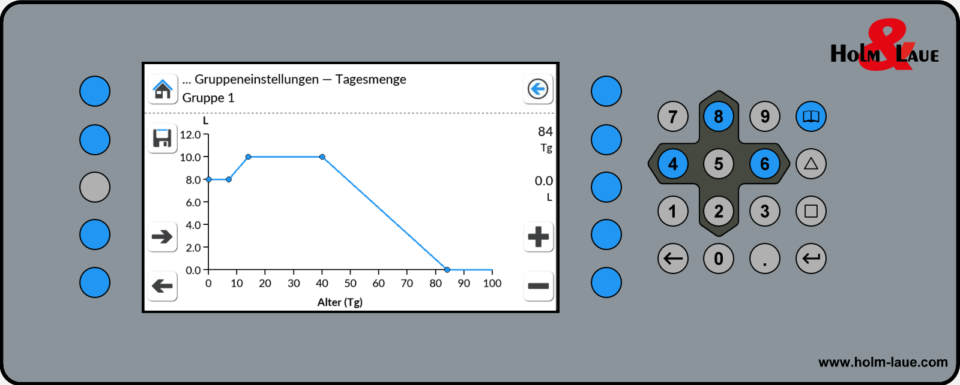
CalfExpert can be used to turn any feeding programme into reality. Feeding curves can be adjusted very flexibly in each of the 8 groups. Up to 16 "turning points" allow you to fine-tune your personal feeding concept down to the last detail. Or you decide in favour of one of the proven and pre-set CalfExpert feeding programmes.
Metabolic programming
Intensive feeding in the first few weeks of a calf's life will usually lead to significantly higher milk production later. However, the correct weaning of calves, for example after an ad libitum phase, poses particular challenges for every calf breeder. With CalfExpert, each calf is slowly weaned off high milk intake, in terms of volume as well as concentration.
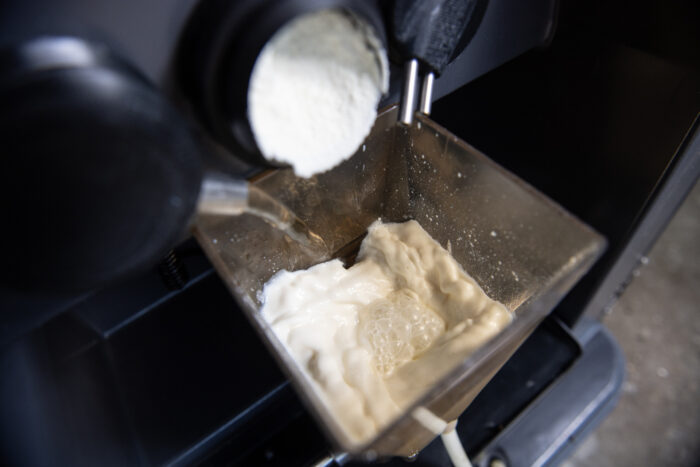
Effective mixing of milk replacer powder
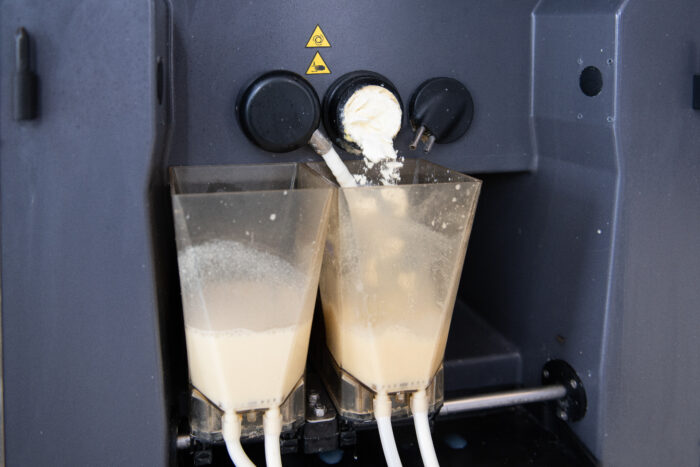
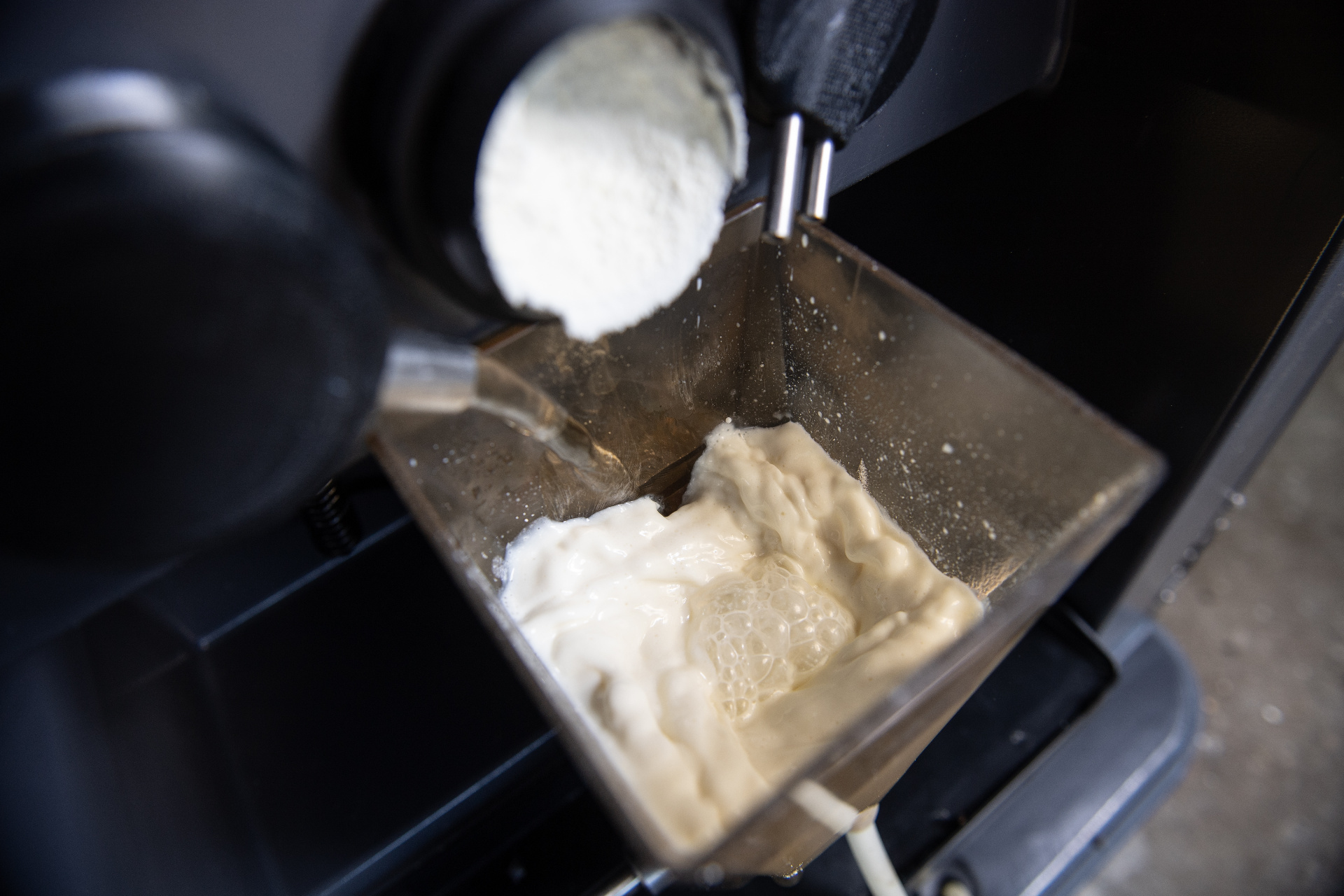
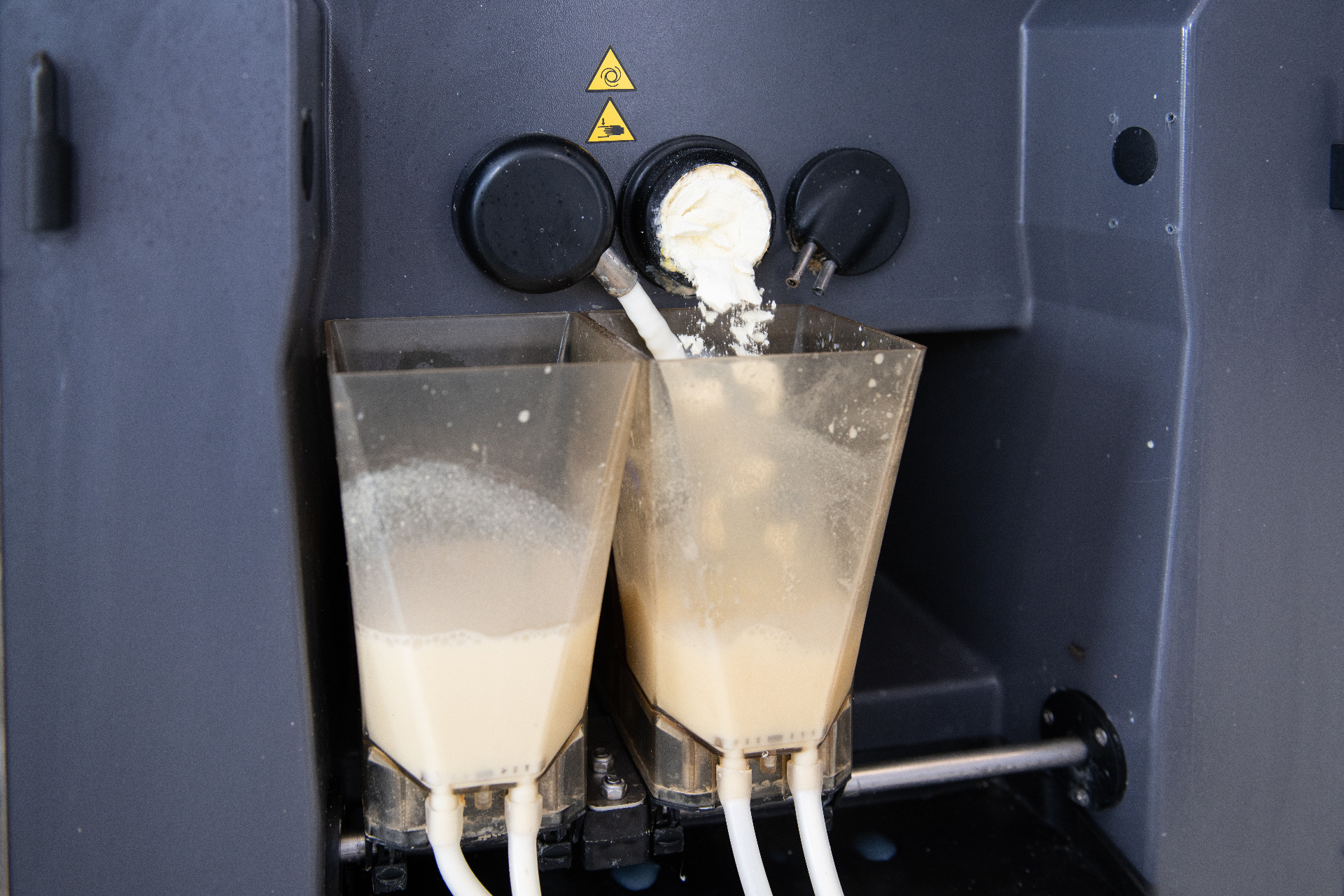
Flexible feeding also means that a wide range of CMRs and additives have to be prepared in an optimum and lump-free way. The continuously variable PowerMixer ensures a soft start to avoid splashing and then stirs the milk replacer powder thoroughly. This means the calf receives its freshly mixed milk directly at the teat in just 3 seconds.
The feeding process can sometimes take longer where young or weak calves are involved. We prevent the separation of the milk replacer powder by slow permanent stirring. And if it gets colder, the heater in the mixer always ensures the mix is kept at a constant temperature, for no matter how long the calf needs.

Second milk powder chamber
The new option allows the CalfExpert to feed two different types of milk replacer (CMR).
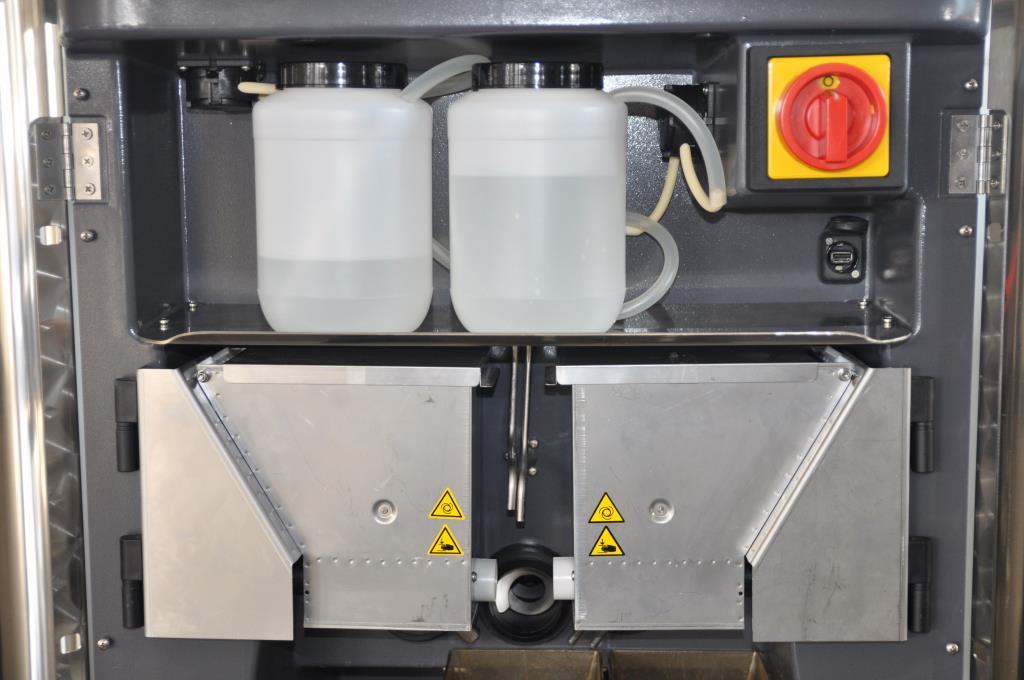
The milk powder compartment is at a 90° angle to the CalfExpert and feeds milk powder into the PowerMixer of the machine via a dosing augur on the side. The volume of 50 kg of CMR can be supplemented by a further 25 kg via the additional powder chamber. This gives the CalfExpert the largest milk powder storage capacity of any automatic feeder on the market, with a maximum powder storage capacity of 150 kg (2 x (50 + 25 kg)). Ideally, this is done in such a way that one type of milk replacer slowly takes the place of the other. This can make sense, for example, if a high-quality skimmed milk replacer is to be used in the first few weeks of life in order to promote the early development of the calves with highly digestible CMR.
Later, cheaper milk replacers can be used, whose ingredients (e.g. certain proportions of high-quality vegetable proteins) are intended to support the transition to ruminant.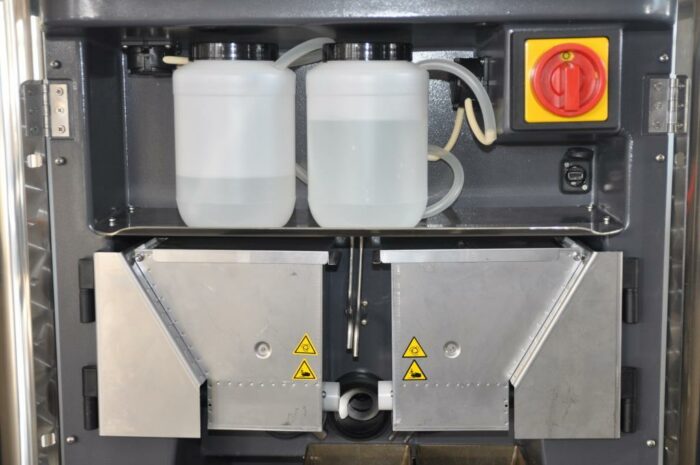
Specific additive feeding
Minimal doses of feed additives can be added to the milk diet in order to stabilise the gastrointestinal system. Sick calves can be treated with medicines in the milk. You can use two powder dosing units and two liquid dosing units. As with the milk programme, you can set different feeding curves for these additives as well. This means maximum flexibility for top calf health.
EvenMilk: intelligent whole milk feeding
Whole milk is digested perfectly by the calf and results in the best performance. With the CalfExpert whole milk programme you can set whole milk proportions or supplement the whole milk in the feeing programme flexibly. What happens with your feeder when the whole milk supply has been used up? Does it then feed powdered milk? This causes changeover stress with your calves and is likely to cause digestion problems. "EvenMilk", our intelligent whole milk control, knows how much whole milk is available and how much is to be fed. It makes sure that whole milk and CMR are mixed in balanced proportions even when whole milk quantities fluctuate daily.




Clean and reliable
A calf feeder is designed to make your work easier and perform continually for 24 hours. To achieve this it has to work reliably under the rough conditions of a calf stall, like the CalfExpert does.
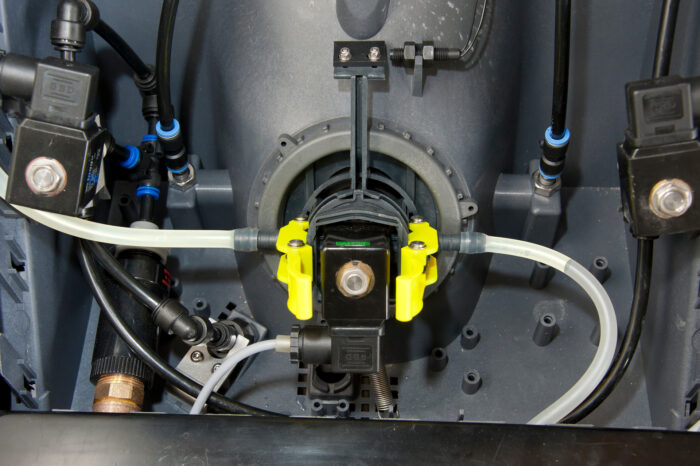
Hose cleaning including the teat
In the past, some hose systems would accumulate deposits of contaminated milk because they could not be cleaned often enough or thoroughly enough. The HygieneStation cleans the entire milk hose until it reaches the teat during longer breaks between feeding. In addition, the entire milk system is cleaned several times a day. When the DoubleJug milk tank is used, the supply line to the CalfExpert is also cleaned automatically. This reduces the bacterial load for the calf, improves calf health and saves on manual cleaning work.
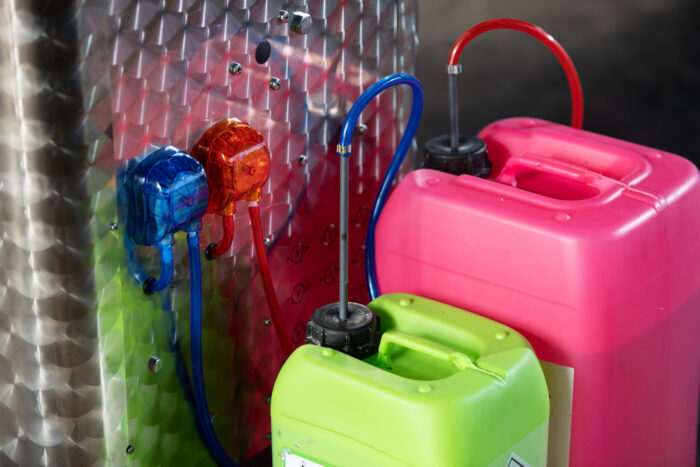
Two cleaning agents
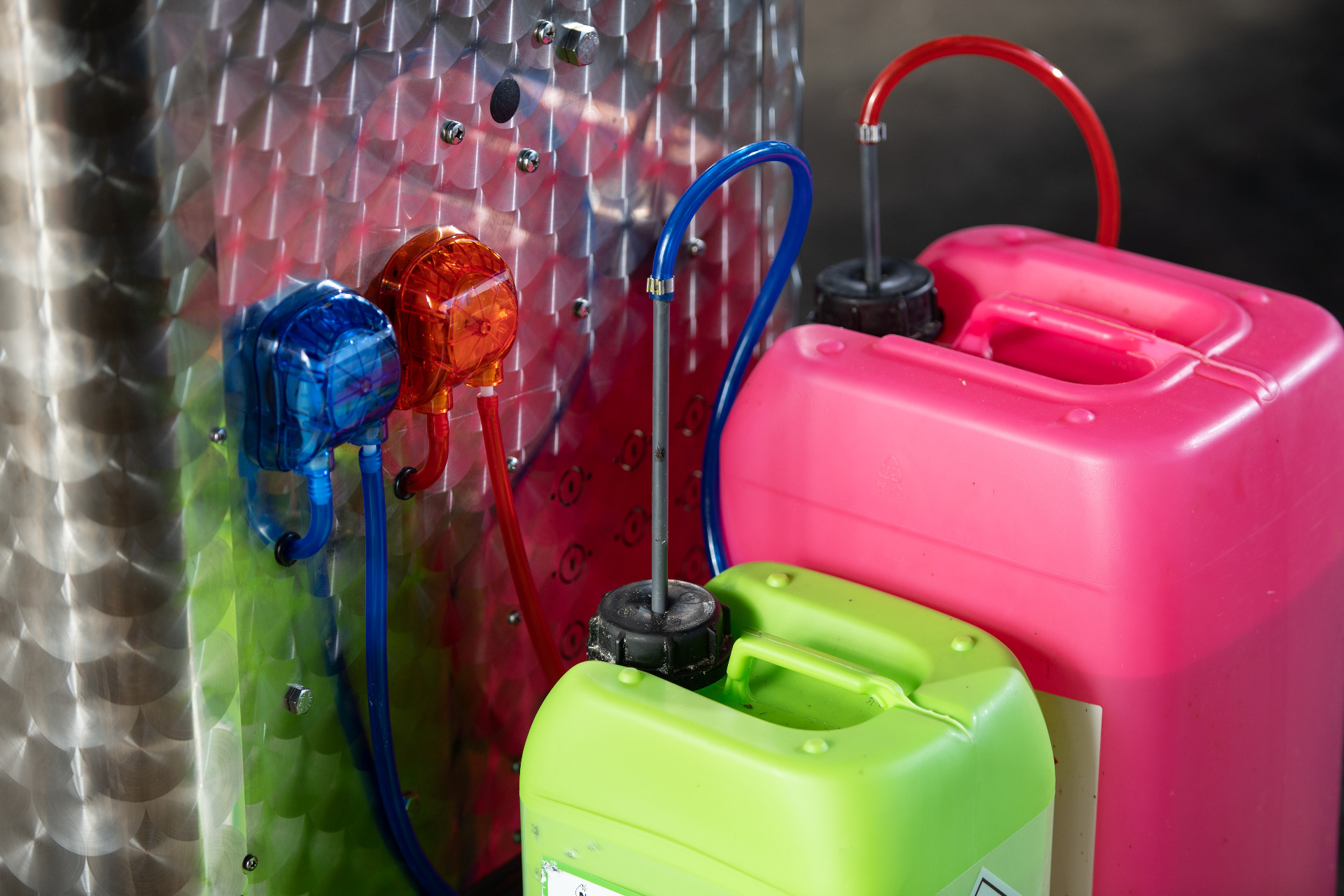
To optimise cleaning even further, the CalfExpert can use two different cleaning agents: either alternate with each cleaning cycle or combine in one cleaning cycle (alkaline, rinse, acid, rinse). The cleaning agent pumps are fitted on the outside. They can thus draw directly from the tanks. This is safe and convenient. In addition, the CalfExpert generates automatic messages as soon as a canister is empty.
Fly shield as standard
Two large doors protect the critical area where the mixer bowls are located. This keeps flies away from the milk and avoids problems in the milk system. The doors can be locked so children cannot be harmed or injured.
Integrated operating instructions
The 7″ graphic display not only allows all calf data to be conveniently viewed. Pressing the key with the book icon opens help texts and information from the operating instructions at every level of the application.
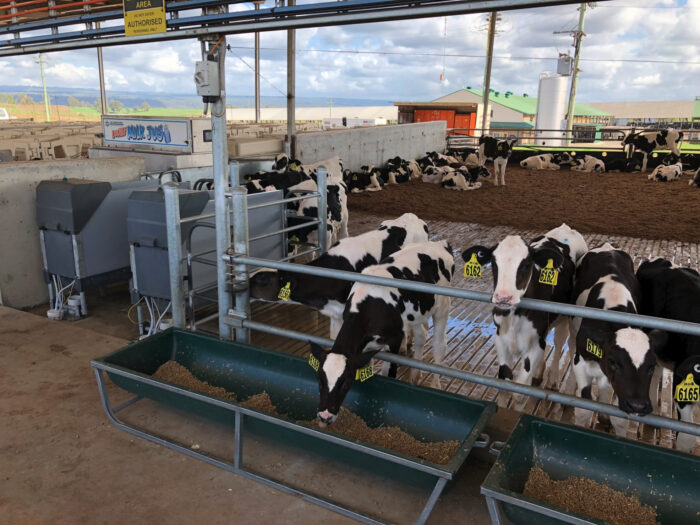
Ready to work whatever the weather
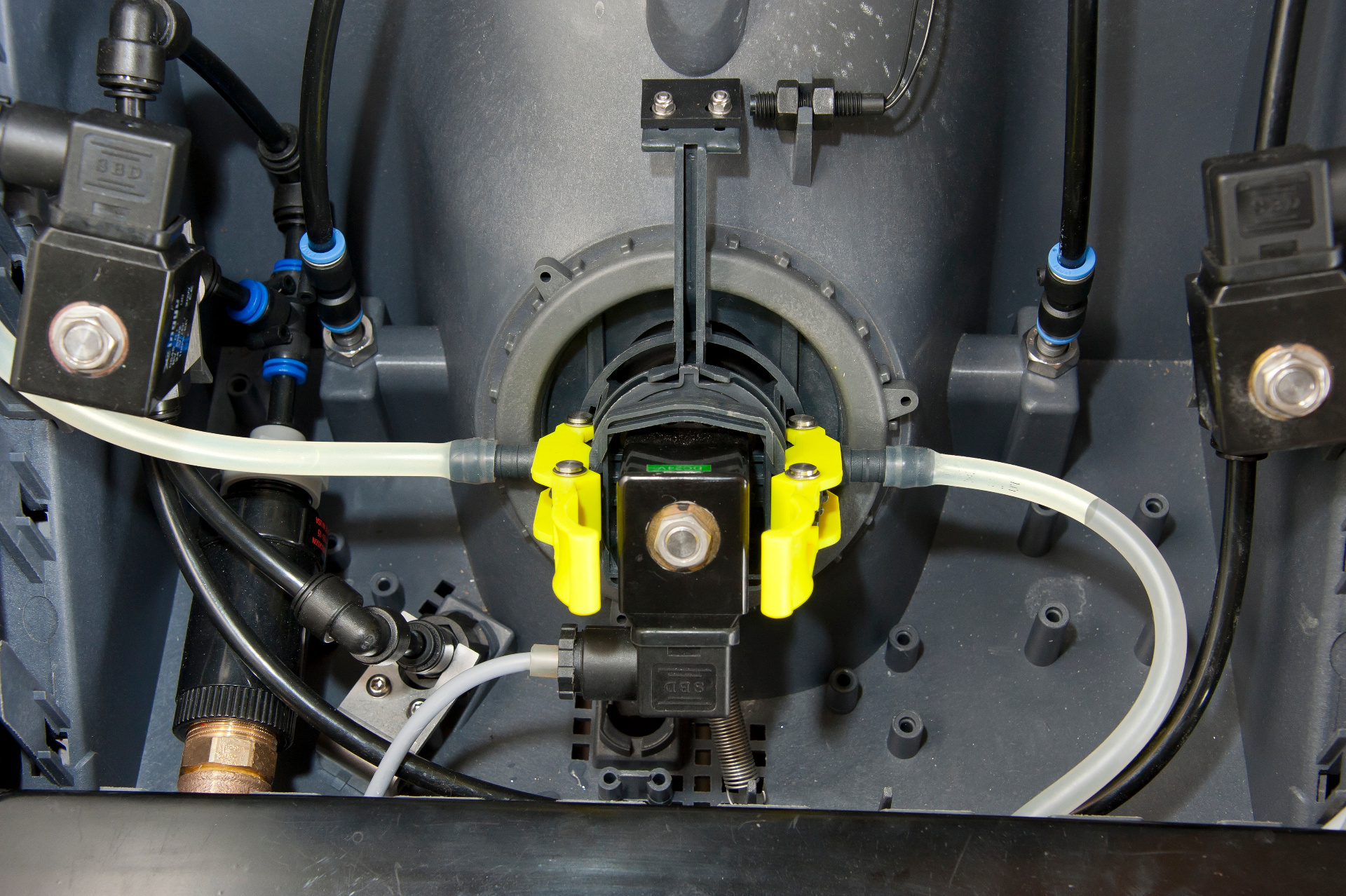
Calves love the outdoor climate, your CalfExpert does too. It comes with a frost protection programme that is activated automatically as soon as there is a risk of frost. Sensors in every HygieneStation and in the CalfExpert mixing chamber measure the ambient temperature and then adapt the mixing temperature and intensity of the frost protection programme accordingly. You can clean the outer surfaces of the automatic feeder with water, since all the sensitive components are water spray-proof.
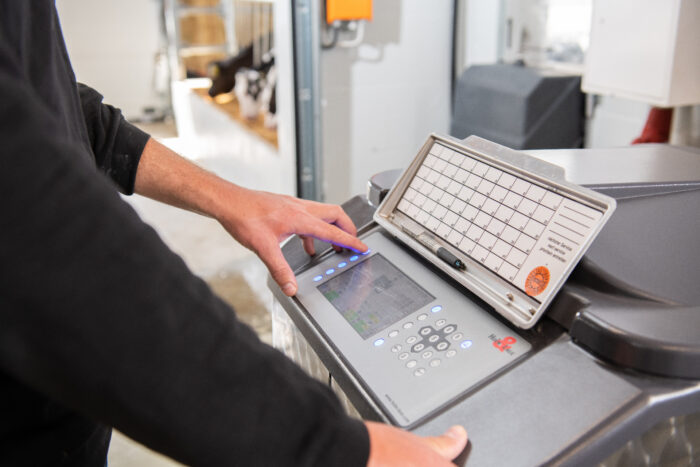
Simple maintenance
Checking the equipment regularly is easy: the maintenance menu allows you to test all important components of the CalfExpert quickly and easily. You can also carry out calibration quickly yourself, because the software always tells you exactly what to do. We recommend that you have your CalfExpert serviced by a qualified technician at least once a year. This provides you with the peace of mind that the automatic feeder will be ready for the next rearing cycle.
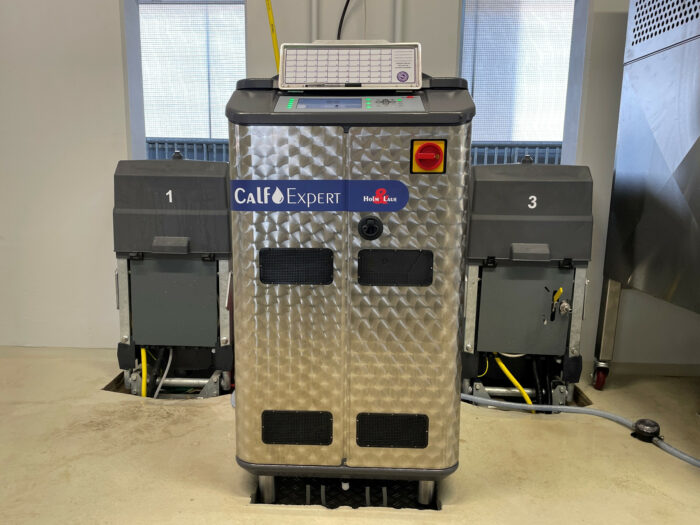
Automatic calibration
The CalfExpert checks the flow rate of milk and water at regular intervals. ensuring a consistent amount of water for the calves without your needing to actively worry about it. Although this unfortunately does not apply to the amount of powder, the machine will remind you as soon as calibration needs to be performed. However, with its Brix-TS option, CalfExpert compensates for deviations in the mix concentration, so that you are always sure that the calves have been fed correctly.
Smarter work – better performance
Kill two birds with one stone: CalfExpert not only frees you up from tedious and strenuous work. Intelligent software and smart operation also increase feeding quality.
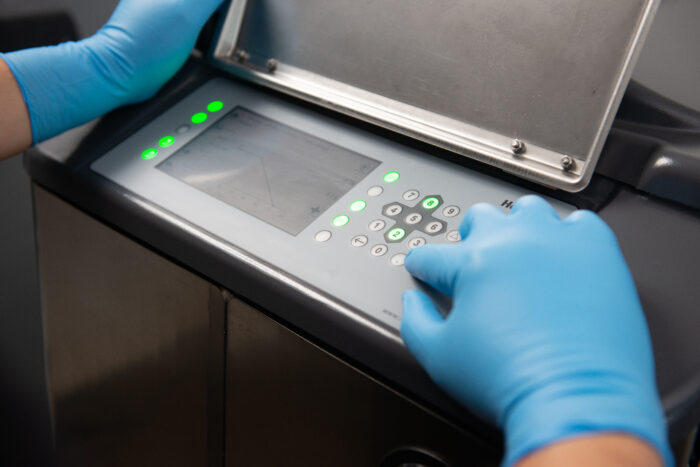
SmartKeys
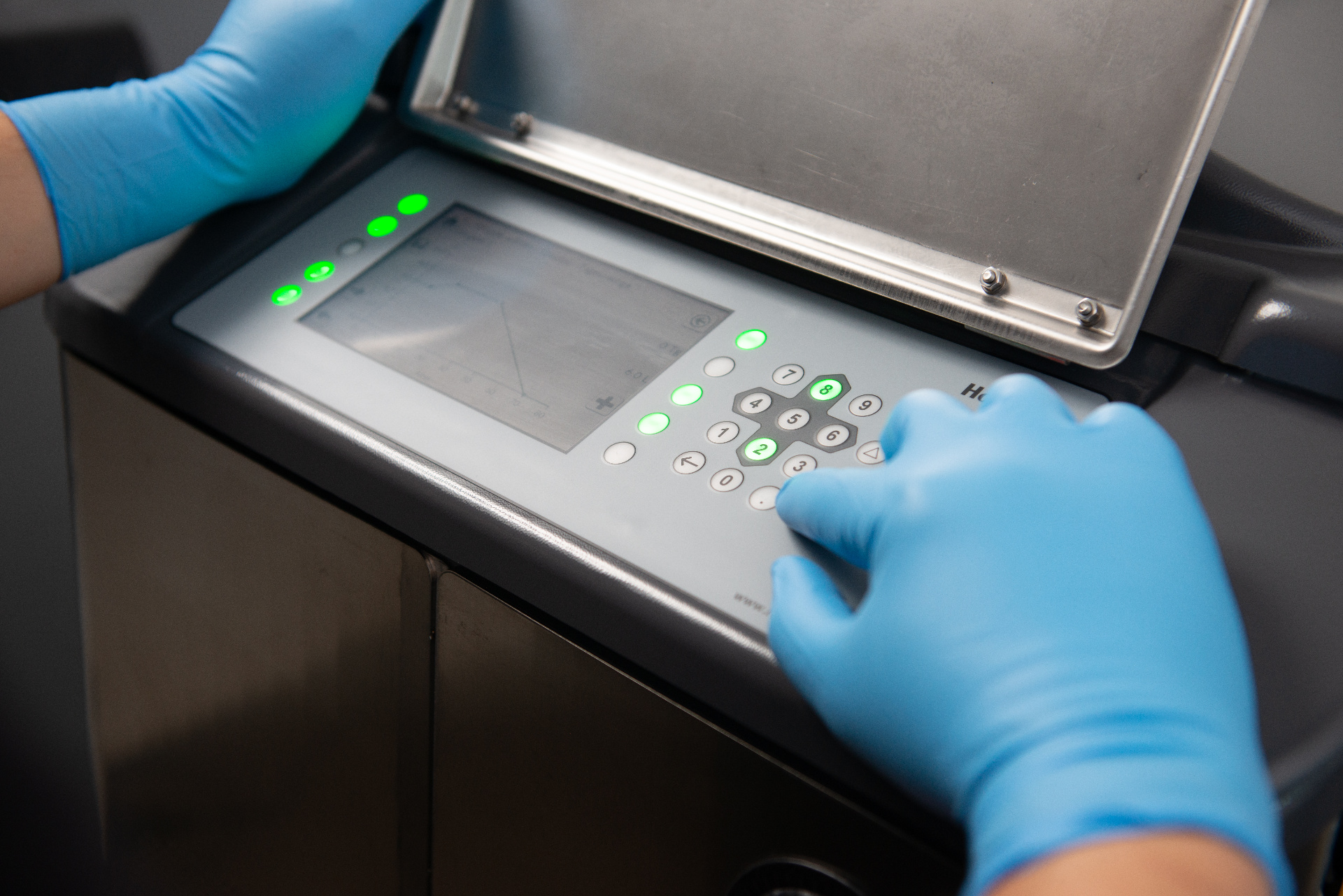
We deliberately avoid the use of touch technology and rely instead on the use of SmartKeys, meaning that a CalfExpert can be operated reliably even in frost, rain, with gloves or even dirty fingers. The illuminated SmartKeys guide you through the programme.
The completely new control software offers maximum clarity and simple CalfExpert operation. All calf data with individual feeding curve, alarm lists, technical parameters etc. can be viewed on the 7" display. The Wi-Fi connection also allows you to retrieve individual items of data on mobile devices and to receive push notifications in the event of error messages.
Higher income thanks to improved performance
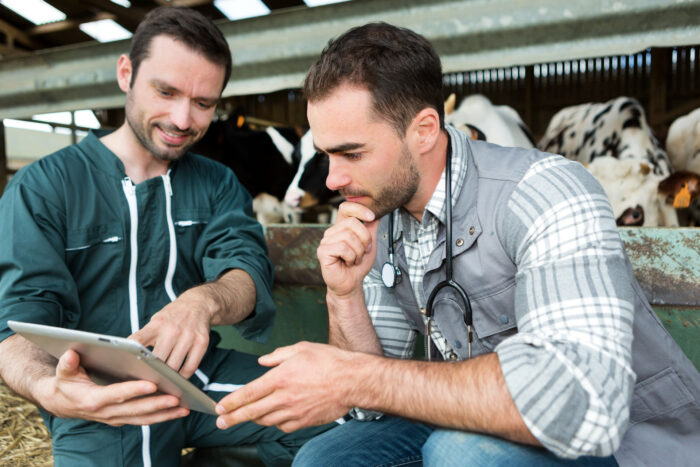
Calves supplied with a lot of energy start lactation at an earlier age and produce more milk later on. CalfExpert also provides you with the best prerequisites for optimum animal health. This means a lower death rate and more animals in the herd reared from your herd offspring. This in turn gives you the opportunity to select the offspring in a targeted manner and to sell surplus heifers at a profit. And last but not least: by saving working time, you are freeing up capacities on your farm that can be used profitably.
CalfGuide app
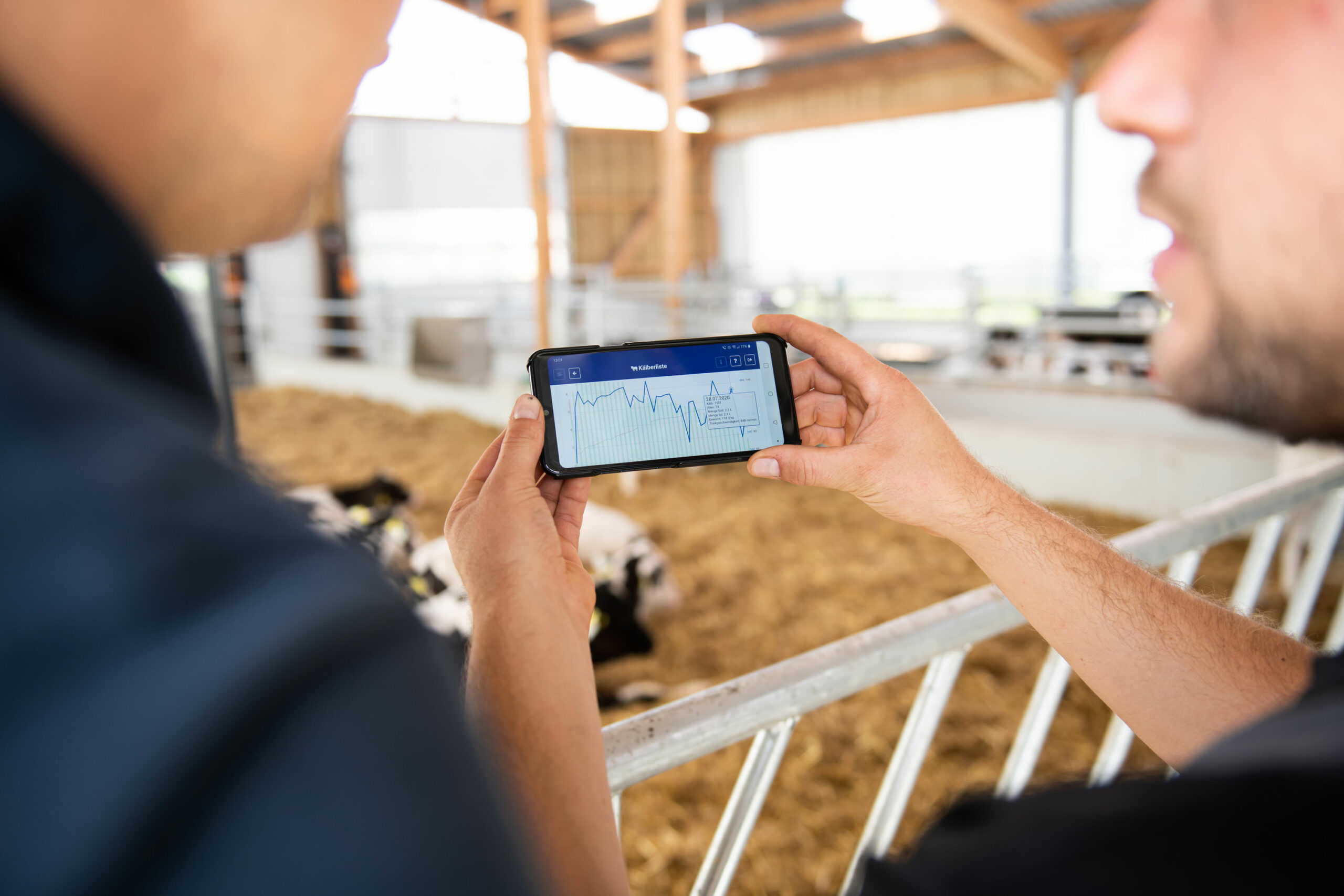
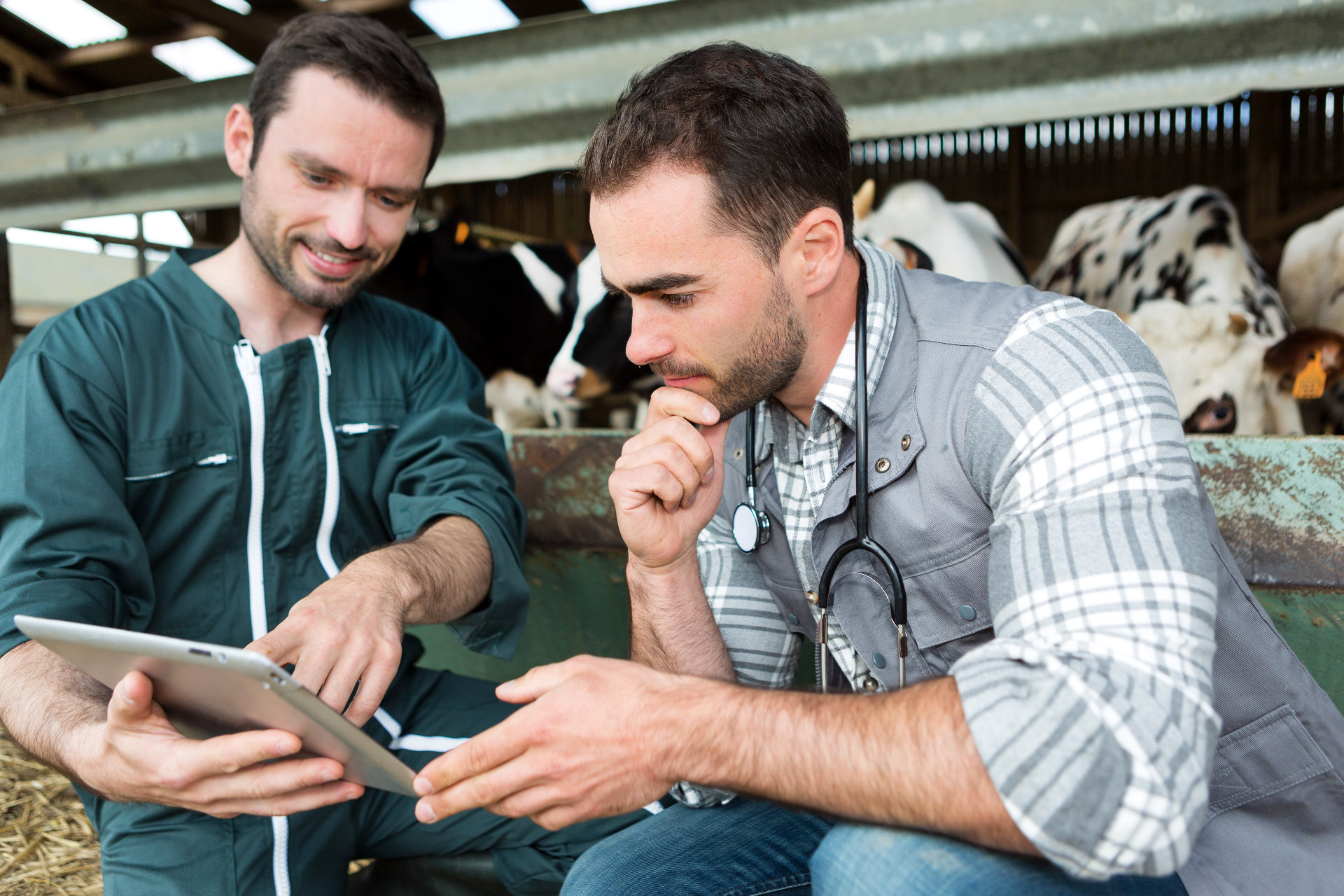
CalfExpert comes with a WiFi interface as standard. The CalfGuide app allows you to access important information directly on your mobile phone. This includes the general calf feeder data and details of the calf lists with the entire calf history. You can easily modify calf information and feeding curves in the app. The CalfExpert also sends messages when the cleaning containers are empty, for example. A particularly practical feature is a health check, which allows you to objectively assess the health of your calves.
AmmoniaDetect
Ammonia irritates the mucous membranes of calves, even in small doses. This can lead to bronchitis in the long run, which can soon turn into pneumonia. Ammonia is only perceived as an odour when it is already in the harmful range. AmmoniaDetect is an electrochemical sensor that permanently measures ammonia levels in the barn air. It is installed directly in the lying area, protected from the calves by a pipe. CalfExpert analyses the measured values continuously and documents them in a chart. This enables you to optimise the ventilation of the calf barn and determine the best time for mucking out.
Gain time and flexibility
Take care of your calves when YOU want and don't let them dictate your day. There are often other jobs and responsibilities to be taken care of in the mornings and evenings in particular: milking and feeding the cows, making breakfast for the family or taking your children to school... CalfExpert feeds your calves. You only have to monitor the machinery and the animals. And training is reduced to a minimum with the new HygieneStation.
Automated work routines
With the CalfExpert, all employees know what they have to do and when. They perform checks, teat changes etc. at regular intervals. The CalfExpert generates timely notifications when whole milk and cleaning agents are running low. And the CalfExpert reports this a few hours before the containers are actually empty to avoid any mad rush.
A feeder that has growing potential
With CalfExpert you can feed up to 100 calves at 4 stations, with QuadroFlex as many as 120 calves. Even if you feed fewer animals today, our modular system allows you to expand the calf feeder machine at any subsequent time with all the options available. So you save money now but can still make use of all the possibilities later.
Equipment and options
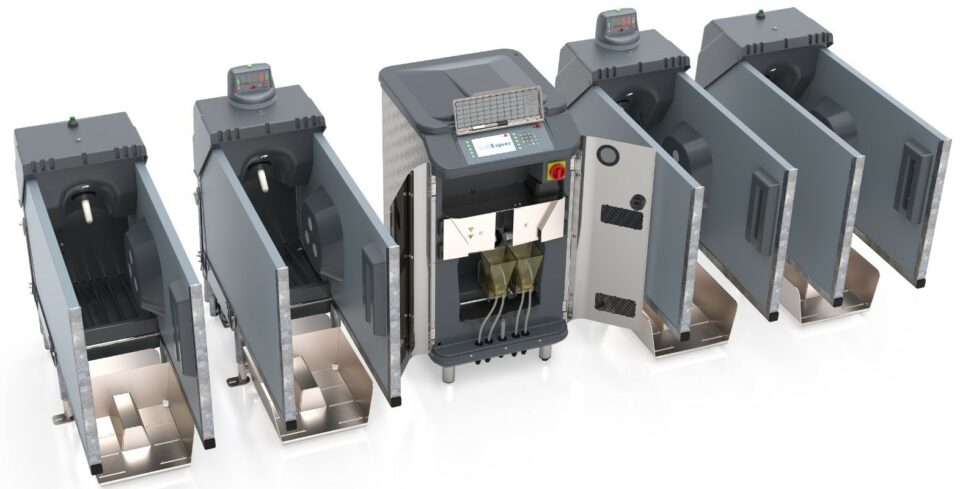
CalfExpert basic configuration
- 1 PowerMixer with SoftStart logic and heater
- Fresh, animal-specific milk preparation
- CalfExpert feeding software with integrated operating instructions and help functions
- 7″ graphic display with SmartKeys
- 8 feeding curves (including metabolic feeding curve)
- Rinsing of mixing tank and suction line
- Two detergent pumps for the automatic cleaning of all milk-carrying components with automatic empty message
- Cleaning temperature up to 65 °C
- Easy-to-clean stainless steel and plastic surfaces
- Powder storage for 50 kg CMR with only 112 cm filling height
- Powerful powder auger suitable for different CMRs
- Automatic registration of new calves
- Individual flexitime programme eliminates stressful feeding times
- QuickChange logic for faster credit switching between the calves
- Data storage capacity for 250 calves
- Self-activating frost protection programme
- Fly protection as standard
- Wi-Fi in the calf feeder as standard
- Free CalfGuide app: all important information on your smartphone
- Automatic calibration of liquid feed
CalfExpert additional options
- Second PowerMixer
- QuadroFlex (feed 4 calves in parallel)
- Up to 4 dosing units for solid and liquid additives
- Powder chamber extension + 25 kg CMR
- Whole milk system
- MilkBoy storage tank
- DoubleJug milk cooling tank
- CalfGuide management system
- Hygiene station (optional including teat cleaning, display, animal weighing scales) (see HygieneStation options)
- Alert lights
- AmmoniaDetect
- Second milk powder chamber
CalfExpert technical specifications
| Power supply and heating performance | 400 V 16 A (6 kW) or 230 V 16 A (3 kW) |
|---|---|
| Capacity with 4 feeder stations | Up to 100 calves (up to 150 in certain cases) |
| Identification system | Multireader HDX and FDX |
| Storage tank for milk replacer powder | 90 l / 50 kg |
| Powder filling height | 112 cm |
| Boiler capacity | 12 l |
| Dimensions | 60 cm x 70 cm x 121 cm |
| Space requirement | 100 cm x 100 cm |
CalfExpert – automatic and personalised calf feeding
The CalfExpert is an automatic calf feeder designed to provide individual milk feeds to calves in group housing. Each registered calf receives a set quantity of whole milk, milk replacer or a combination of both, in accordance with its programmed feeding curve.
| Characteristic | CalfExpert |
|---|---|
| Feeding system | Automatic, individualised milk feeding |
| Suitable for | Calfs kept in group housing |
| Animal feed | Whole milk, milk replacer, feed supplements, medicines and defined mixtures of these |
| Animal recognition | Individual identification of calves using ISO RFID |
| Feeding programmes | Up to eight programmable feeding curves for milk volume and concentration |
| Milk preparation | Fresh preparation of calf’s milk in individual portions |
| Whole milk management | Managing fluctuating whole milk volumes with EvenMilk, forecasting whole milk consumption with WholeMilkSmart |
| Milk replacer | 50 kg (until 150 kg) powder capacity; depending on the options, up to two different types can be used |
| Additives | Dosing of powdered and liquid additives |
| Feeding stations | It is possible to supply several geographically separate groups of calves with four HygieneStations |
| Hygiene | Daily automatic cleaning of the milk-carrying pipes until the teat |
| HygieneStation | Teat cleaning, rinsing of the saliva tray and integrated management functions |
| Animal control | Recording of milk intake, feeding frequency, drinking speed, physical and facial development, and other feeding data |
| Weighing | Automatic weight recording at suitably equipped HygieneStations |
| Watering | Tailored to each animal’s age or weight gain |
| Whole milk storage | Automated tank systems such as DoubleJug can be integrated; with the SmartWash option, standard milk tanks can also be cleaned automatically |
| Operation | Centralised control and digital calf management via the CalfExpert unit itself or via the free CalfGuide app |
| Extensibility | Modular design, adaptable to farm size, feeding system and barn layout |
Briefly:
A brief summary: The CalfExpert combines automatic milk feeding with individual calf management. It is designed to reduce routine work, spread the supply throughout the day and provide those in charge with up-to-date data on each calf. However, the calf feeder does not replace daily observation of the animals, monitoring of barn conditions or consistent hygiene management.
42 frequently asked questions about automatic calf feeders
Questions and answers about the CalfExpert calf feeder
Principles and scope of application
An automatic calf feeder, such as the CalfExpert, recognises each individual calf and provides it with a defined portion of milk in accordance with a pre-set feeding programme. Among other things, the milk volume, concentration, number of meals, feeding restrictions and weaning schedule can be individually controlled.
The milk meal is provided at a feeding station, such as the HygieneStation, which is designed to meet the specific requirements for natural feeding behaviour in calves.
The system thus combines group housing and social contact with an individualised milk supply for each animal. At the same time, it records feeding data such as milk intake, number of visits and feeding behaviour.
Automatic feeding systems, such as the CalfExpert, enable individual milk allocations within a group and continuously generate dates on the calves’ intake and visit behaviour.
The CalfExpert recognises a registered calf at the feeding station (HygieneStation) and checks whether it is entitled to milk. The feeder then prepares the prescribed portion, transports it to the HygieneStation and dispenses the feed via the teat. This process usually has a duration of less than 5 seconds.
Feeding is based on the calf’s individual feeding curve. Visits, milk intake and other dates are recorded and are available for daily animal monitoring.
A calf feeder such as the CalfExpert is particularly suitable for operations that keep calves in groups, wish to control milk intake on an individual basis, and want to reduce the fixed working hours associated with manual feeding.
Herd size is not the only decisive factor. Essential requirements include a suitable barn layout, reliable daily animal monitoring, good hygiene, trained staff and a well-organised supply system for milk, water, power and cleaning.
There is no universally applicable minimum number. Economic viability depends, amongst other things, on the number of calves being milk-fed at any one time, the organisation of labour, labour costs, the housing structure, the feeding programme and the desired level of automation.
A robust comparison should take into account investment, running costs, working hours, feed costs and management benefits.
The technically feasible capacity is not automatically the optimal assignment from a business or animal health perspective.The appropriate number depends on the options, the number of feeding stations, the programmed milk volume, the feeding schedule, the age of the calves and the barn layout. It should therefore be planned individually for each operation.
A high theoretical capacity of up to 120 calves should not be regarded as a target stocking density.
Waiting times, group size, health status and accessibility to the station must be taken into account in the planning. The specific design should be carried out by an authorised Holm & Laue partner.Yes. Depending on the system design, a central CalfExpert unit can be connected to up to four HygieneStations, thereby supplying separate groups of calves. Various pens can be set up within the CalfExpert control system, which makes it easier to locate the calves within their groups.
The groups can be organised, for example, by age, health status or management phase.
The milk flow, station utilisation and hygienic separation must be taken into account at the barn planning stage. Holm & Laue provide a public description of practical installations featuring more stations and groups.Fundamentally, yes. Whether the investment makes sense depends more on the number of calves to be supplied at any one time and how the work is organised than on the total number of dairy cows.
Even smaller operations can benefit from more flexible working hours and individualised feeding. However, if there are very few calves, a mobile or manual solution may be more cost-effective.
Fundamentally, automatic feeding can also be used on organic farms. The key factors are the applicable legal and association-specific requirements, particularly regarding husbandry, milk feeding, feeding duration and group size.
The technical system must therefore be adapted to the specific organic regulations and the operation’s operational concept. In particular, the wide range of options for whole milk management and storage offered by the CalfExpert makes it very popular with organic farms.
There is no single ‘best’ automatic calf feeder. Which system is best suited to a particular operation depends on factors such as herd size, housing design, feeding strategy and management objectives.
Key selection criteria include hygienic milk preparation, individual feeding, reliable animal recognition, meaningful management data, easy operation and expert after-sales service.
We are convinced that the CalfExpert is the technologically leading automatic calf feeder on the market. It combines fresh preparation of any milk portion, flexible feeding with whole milk and milk replacer, automatic cleaning until the teat, comprehensive management data and a modular structure suitable for farms of various sizes.
Other manufacturers also offer high-performance solutions. We therefore recommend comparing calf feeders not only on the basis of purchase price, but above all in terms of feeding quality, hygiene standards, data management, expandability and service. Anyone taking these criteria into account will find the CalfExpert among the very best.
Milk and feed programmes
Yes. The CalfExpert can use whole milk as the sole source of milk or as part of a combined feeding programme.
For safe whole milk feeding, storage, cooling or processing, transport and cleaning must be planned with hygiene in mind. With EvenMilk, the CalfExpert can combine available whole milk and milk replacers in defined proportions.
With WholeMilkSmart, milk storage is optimised across a wide variety of systems. A consumption forecast and planning of the required refill level are important management tools.
Yes. The CalfExpert prepares milk replacer in individual portions for each calf. The PowerMixer mixes powder and water and keeps the consumption in motion and at as constant a temperature as possible during prolonged suckling sessions.
To ensure consistent dosing, the milk replacer, water and powder quantities must be subject to regular calibration. Different products or batches may have varying flow and bulk densities.
If required, it is even possible to perform feeding with two different types of milk replacer.
Yes. The system can combine whole milk and milk replacer, or fortified whole milk, according to a defined programme.
The EvenMilk control system distributes fluctuating quantities of whole milk as evenly as possible across the designated rations. This is intended to prevent individual calves from switching abruptly between pure whole milk and milk replacer.
The second milk powder compartment allows two different milk replacers to be stocked and used in accordance with programmed feeding curves.
This enables, for example, a gradual switch between two products. The suitability of the products, dosing and transition strategy should be agreed with the feed consultant.
In addition, the storage capacity increases to 100 kg of CMR. With appropriate powder chamber extensions, up to 150 kg of CMR can be stored on the CalfExpert.
The CalfExpert can be fitted with two powder dispensers and two liquid dosers as optional options. This allows suitable additives to be dosed according to pre-set programmes.
It must be clarified before whether a product is technically suitable for dosing, permitted under feed legislation and appropriate for the individual calf. Medicinal products may only be used in accordance with veterinary instructions and the applicable legal requirements.
The supplementary programmes can be set on an individual animal basis or for specific groups.
The appropriate amount of milk depends on body weight, age, breed, state of health, nutrient concentration, ambient temperature and rearing objective. A standardised no. of litres is therefore not suitable for all calves.
Modern programmes are increasingly based on body weight and provide young calves with more generous supplies than traditional restrictive systems. The specific feeding curve should be determined in consultation with a feeding adviser and a vet, and reviewed on the basis of growth, faecal consistency, starter feed intake and health data. Systematic reviews show that milk volume and feeding methods influence behaviour and performance; however, they do not identify a universally optimal no. of litres for all operations.
CalfExpert offers three standard feeding curves corresponding to different feeding intensities.
This depends on the programmed daily quantity, the portion size and the set restricted feeding times. A key advantage of automatic systems is that the daily ration can be divided into several smaller meals.
However, portions that are too small can lead to many unsuccessful visits, whilst very large individual portions limit the desired distribution.
The programme must therefore be tailored to the calves’ age and the total daily ration.Ideally, Holm & Laue recommends between 4 and 6 visits per day. The minimum quantity should be approximately 2 litres per visit.
An automatic calf feeder, such as the CalfExpert, can provide very large quantities of milk or virtually unlimited access to milk. However, ‘ad libitum’ does not mean that management and monitoring are no longer required.
Milk quality, temperature, cleanliness, starter feed intake, water supply and weaning strategy remain crucial.
Where milk volumes are high, the subsequent weaning must be planned with particular care.For animal monitoring, the CalfExpert uses different alarm parameters to those used in restrictive feeding systems, in order to reduce false-negative results.
CalfExpert uses feeding curves for feeding groups. These take into account milk intake, concentration and weaning progression depending on the calves’ age or stage of development.
Individual programmes are possible, particularly when weaning off milk, based on body weight or concentrate feed intake. Feed supplements can be administered on an individual basis.
When preparing milk replacer, the machine supplies water at the specified temperature. The heated PowerMixer helps to maintain as constant a temperature as possible, even if a calf drinks for a longer period.
The actual temperature at the teat should nevertheless be checked regularly. Long pipework, ambient temperature or technical variations can affect the result.
It is not possible to carry out feeding with milk that has already been acidified in the storage tank, as there is a risk of it flocculating when heated in the CalfExpert. However, it is possible to carry out dosing of feed acids directly in the milk that has already been heated in the PowerMixer.
With CalfExpert, each portion of milk is freshly prepared individually for each calf. If a calf does not drink its entire allocated portion, the residual quantity is initially kept in the PowerMixer for the calf. If the calf does not drink the residual quantity within the next few minutes, it is rejected.
If, during this time, another calf is entitled to the same milk mixture, that calf may drink the milk. The corresponding quantity is then allocated to the second calf.
If a calf arrives at the station that is not supposed to receive this mixture, the milk mixture is rejected and the calf is given a fresh mixture in accordance with its own formula.
Calfs, groups and training
There is no fixed age limit that applies to any operation. The calf should be healthy, have received sufficient colostrum, be able to drink reliably from a teat, and be suitable for close monitoring.
Both very early and later moves are possible. The decisive factors are health status, housing design, group composition and the quality of the training process. In practice reports by Holm & Laue, calves are transferred to the CalfExpert just a few days after birth; however, scientific studies show that the timing of introduction must always be considered in conjunction with a healthy environment, performance, welfare and labour requirements.
The calf is led to the feeding stall and helped to find the teat and start drinking milk.
The automatic training aid assists farmers in this process. When the calf moves the teat, a small quantity of milk is squirted into its mouth. It then usually starts drinking quickly.
Once it has understood the connection between the stall and the milk, the help should be gradually reduced.
The first few days must be closely monitored. Milk intake, successful visits and changes compared with the previous day indicate whether a calf can manage independently or requires further support. In a practical comparison, Holm & Laue often cite two to three days for the training phase; the actual duration may vary.
Warning signs include low milk intake, few successful visits, repeated unsuccessful visits, a marked decrease in drinking speed, or a change from the animal’s usual behaviour.
These dates must always be assessed in conjunction with a direct examination of the animal. Weakness, diarrhoea, respiratory diseases, lameness, competition within the group or technical problems can cause similar changes.
This depends on the calf’s state of health. A calf with mild health issues may be able to remain with the group under close observation; a severely ill, weak or non-self-feeding calf often requires separate supply.
By conducting a detailed analysis of the calf data, emerging illnesses can be detected and treated at an early stage.
The decision to treat should be made in accordance with a farm health protocol and, where necessary, in consultation with the vet. The feeder records feeding behaviour but does not make a diagnosis.
Group housing facilitates social interaction, shared learning and more behavioural options. Scientific overviews highlight the benefits of social housing, but also note that health risks must be minimised through effective management.
Key requirements include small, stable groups, sufficient space, good air quality, dry resting areas, hygienic feeding stations and consistent monitoring of the animals.
There is no universally optimal group size. It depends on age, space requirement, the number of feeding stalls, the feeding programme, health status, ventilation and work organisation.
Smaller groups, ideally comprising calves of similar ages, often make monitoring and training easier.
Regardless of the group size, every calf should be able to reach the feeding stall easily, without being constantly pushed aside or having to wait for long periods.Large age differences within a group are usually undesirable. Younger calves may be displaced by older and stronger animals and may face a different risk of infection.
In practice, groups of similar age that remain stable, with a maximum age difference of 2–3 weeks, are easier to manage. Frequent regrouping should be avoided, as it causes unrest and introduces the animals to new companions.
Mutual sucking can also occur with automatic feeding, but is not necessarily a consequence of the feeder. The risk and frequency are influenced, amongst other things, by milk volume, meal distribution, sucking duration, teat resistance, hunger, weaning strategy and engagement.
An adequate milk supply, a suitable teat, a longer natural suckling duration (approx. 500–600 ml/min) and a gradual weaning process can reduce the risk.
Hygiene and operational safety
The CalfExpert features automatic cleaning programmes for all milk-carrying system areas. When used in conjunction with the HygieneStation, cleaning can extend until the teat; furthermore, the teat and saliva tray are rinsed between animal contacts.
Automatic cleaning does not replace all manual tasks. External surfaces, the station, teats, storage containers and hard-to-reach areas must be checked in accordance with a fixed hygiene plan and cleaned manually where necessary.
The milk-carrying components must be cleaned automatically on a regular basis in accordance with the manufacturer’s instructions and the farm’s hygiene plan. The CalfExpert can be cleaned automatically, for example, twice daily. In addition, daily visual and function checks, as well as specified manual cleaning tasks, are required.
The required frequency depends on the feed, temperature, utilisation rate, pipe length and system configuration. The current operating manual and the results of the farm’s own hygiene checks are decisive – not a generalised statement found on the internet.
The CalfExpert HygieneStation performs cleaning of the teat and rinses the saliva tray using the QuickDrain system. This is intended to reduce the spread of saliva and dirt between animals.
Nevertheless, the state of the teat must be checked daily. Wearing parts must be replaced, cleaned and disinfected in accordance with the hygiene plan.
Shared teats and group housing can create routes of transmission if hygiene, barn climate or animal management are inadequate. A calf feeder is therefore neither automatically a health risk nor automatically a safeguard against disease.
The risk can be minimised by teat cleaning or replacement, ensuring clean pipework, keeping small, stable groups, providing good ventilation, using dry bedding and isolating sick animals promptly.
The quantities of water, powder and, where applicable, whole milk must be calibrated regularly and verified by control measurements. The temperature and the actual concentration of the mixture should also be checked.
All liquids in the CalfExpert can be calibrated automatically.
For powdered feed, the CalfExpert issues an alert if the calibration intervals have been too long.A new batch of milk replacer may require recalibration due to changes in bulk density. Specialist organisations recommend regular calibrations as well as further checks when changing products or batches.
Without power or water, the feeder cannot prepare, dispense or perform cleaning of milk properly. Any operation therefore needs a documented emergency plan for the manual supply of all calves.
This includes accessible replacement equipment, a sufficient number of clean buckets or bottles, available milk, clear lines of responsibility and emergency procedures. Possible emergency power and alarm options must be agreed on a farm-by-farm basis with specialist partners and electricians.
The CalfExpert automatically compensates for short-term power cuts and starts independently. However, power surges can damage electronic components.
With the CalfExpert, EvenMilk can distribute the available whole milk in combined programmes in such a way that whole milk and milk replacer are used as evenly as possible. This is intended to reduce abrupt changes.
The exact response depends on the set feeding programme and the system configuration. The options range from automatic switching to milk replacer or pausing milk preparation. The stock levels and the milk supply function must therefore continue to be checked daily.
In a system designed for this purpose, DoubleJug or compatible whole milk systems can be incorporated into the automated cleaning sequence. This also allows the pipes between the tank and the CalfExpert to be cleaned.
Where third-party tanks are used, additional valves, cleaning lines, spray heads or electrical modifications (known as SmartWash) are required. The technical design must be planned and approved on a case-by-case basis.
Data, a healthy environment and watering-off
Typical dates include the allocated and actual milk intake, successful and unsuccessful visits, drinking speed and changes over time. Depending on the options, body weight and weight development may also be included.
It is not just a single measurement that is particularly meaningful, but the deviation from a calf’s individual growth curve. Automatic systems thus provide valuable information for daily animal monitoring.
A calf feeder can show behavioural changes that may be linked to an illness. A decrease in milk intake, drinking speed or the number of successful visits are possible warning signs.
However, the data is not sufficient for a definitive diagnosis.
Scientific studies rate it as a screening and early-warning tool, not as a substitute for direct clinical assessment by trained personnel or a vet.When used in conjunction with suitably equipped HygieneStations, body weight can be recorded automatically during a visit to the station. This provides a regular record of weight development without the need to take each calf to the scales individually.
Weight data helps to monitor progress and can be incorporated into a weight-based weaning strategy.
Any conspicuous values should be checked, as the calf’s position, movement or soiling may affect the individual measurement.In continuous weaning, the amount of milk available is reduced over a set period of time. The CalfExpert can use individual feeding curves for each animal and – with the appropriate options – weight data for this purpose.
Weaning should not be based solely on the calendar. Age, body weight, health status and a stable intake of calf starter feed and water must all be taken into account. Studies show that automatic systems can support a gradual weaning process tailored to the individual animal.
An automatic calf feeder can significantly reduce the routine work for preparing, portioning and dispensing milk, and make working hours more flexible. A study by Teagasc found greater labour efficiency compared with manual milk feeding, whilst weight gains were comparable.
However, the time saved on feeding must not be completely disregarded. It should be used for observing the animals, hygiene, data analysis, bedding and health checks. The greatest benefit therefore does not come from ‘less work with calves’, but from a different and more targeted distribution of the work.
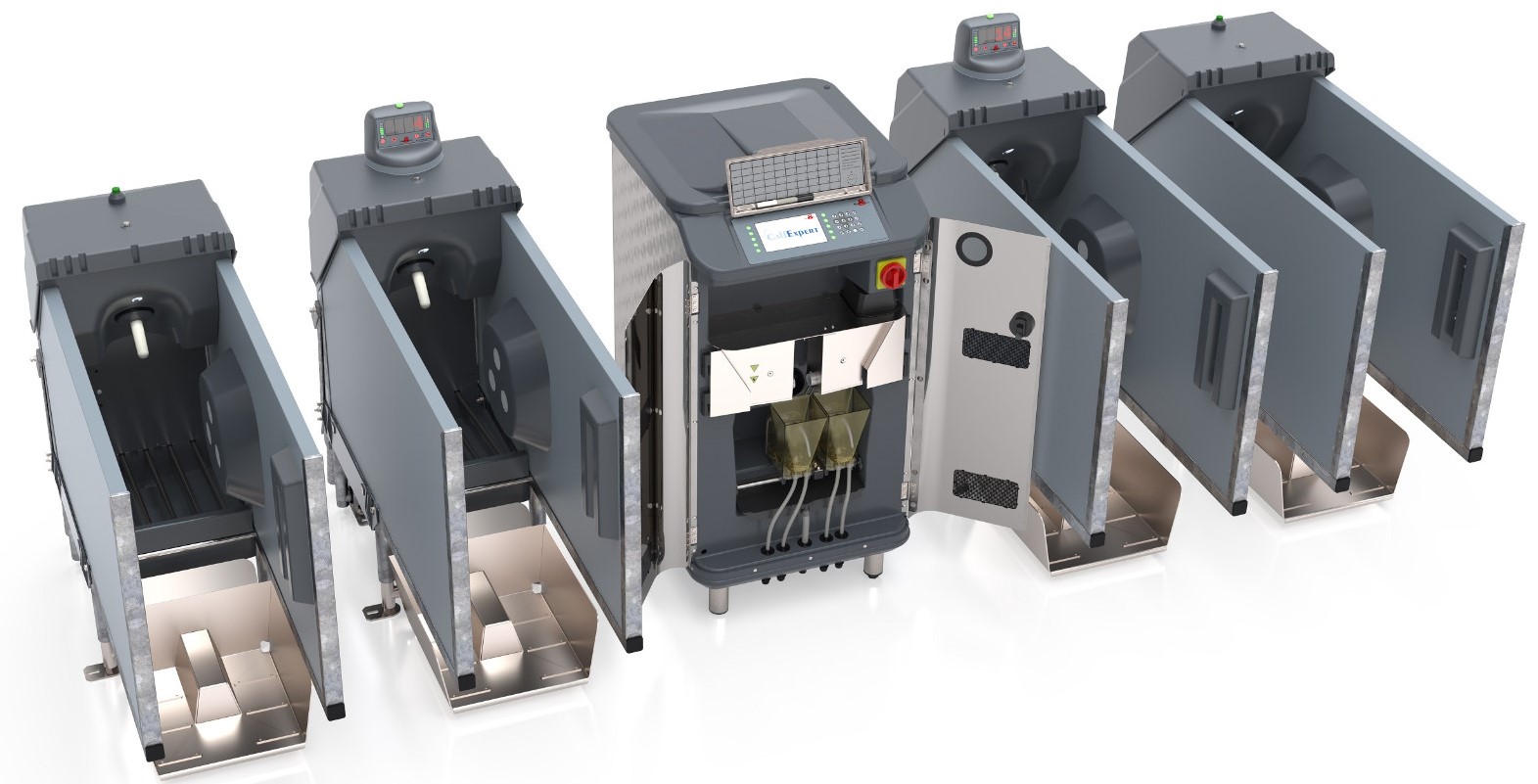 CalfExpert with 4 stations